Physical interactions that bring relief to clinical conditions
Case Study – Lamellar Biomedical
Drying is a critical step in many industries, such as food, coating, agriculture, cosmetics, pharmaceuticals, and biomaterials and is often one of the most energy-intensive processes. However, it remains poorly understood due to a lack of controlled studies, limiting the development of more sustainable technologies and products. During drying, a range of defects, such as shrinkage, wrinkling, delamination, cracking, pinholes, and shear banding, can develop and compromise product quality and performance. Both formulation and process conditions play a critical role in defect formation. At the Edinburgh Complex Fluids Partnership (ECFP), we help organisations across sectors and scales optimise formulations and drying processes through controlled drying studies.
Understanding how a formulation behaves during application and drying is key to consistent performance and product quality. Characterisation links formulation and microstructure to processing behaviour and final material properties. At ECFP, we use a range of rheological, chemical, and microstructural (particle-level) characterisation techniques to link formulation structure, processing behaviour, and final performance. Our rheological capabilities include shear and extensional rheology, microrheology, confocal rheology, rheo-imaging, and capillary rheometry, enabling tailored characterisation of formulations across different processing stages such as spraying, brushing, rolling, and drying.
The drying behaviour of formulations is governed by evaporation kinetics and environmental conditions, often leading to skin or crust formation that slows drying and increases processing costs. At ECFP, we design bespoke controlled drying studies tailored to industrial needs, covering thin-film coating processes such as dip, spin, blade, and spray coatings. We also have expertise across confined [1,2], droplet [3,4], and vertical drying configurations, enabling systematic studies of drying behaviour under well-defined conditions. Our work spans a wide range of materials, including colloids, polymers, proteins, cellulose-based systems, and complex formulations.
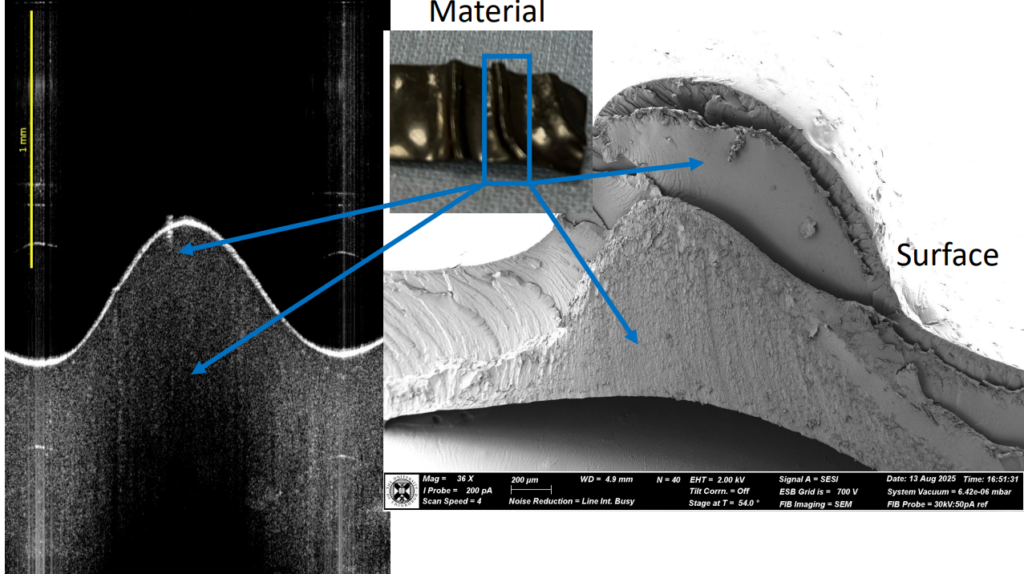
Our drying process characterisation capabilities enable detailed quantification of drying rates, drying times, skin or crust formation, and film thickness. Advanced imaging techniques, including confocal microscopy and optical coherence tomography (OCT), provide real-time visualisation of the drying process. Substrate properties are also characterised through contact angle measurements and diffusivity studies to understand liquid transport and evaporation in porous materials.
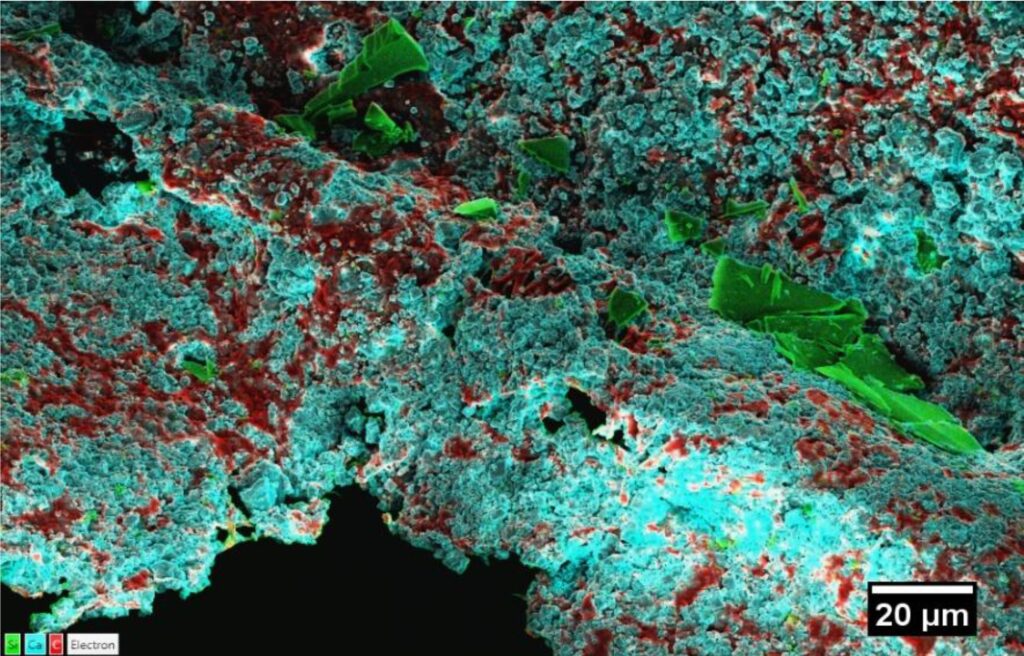
We have advanced microscopy facilities such as scanning electron microscopy (SEM), cryogenic (cryo)-SEM, and cryo-focused ion beam (FIB)-SEM. Cryo-SEM uniquely allows direct investigation of wet formulations, allowing direct observation of defect formation during drying. Cross-sectional FIB-SEM analysis reveals drying-induced microstructural evolution across cross-sections at the nanopore scale. Cryo-SEM combined with Energy-Dispersive X-ray (EDX) Spectroscopy allows identification and mapping of elements within formulations and materials. Mechanical properties of dried films, including strength, stiffness, and fracture behaviour, are quantified using a universal testing machine (UTM). Complementing these experimental approaches, we also develop modelling tools to predict drying behaviour and drying process conditions [5].
[1] H. Pingulkar et al., Soft Matter, 2024 : This work developed a quantitative approach to study drying of colloidal dispersions using water potential measurements using a microfluidic chip. The study identified two distinct drying regimes: an initial stage where a porous solid formed and grew linearly within the channel, followed by a slower drying stage caused by the invasion of the porous structure by air–water nanomenisci. By revealing how drying behaviour evolves within nanoporous structures, this work provides fundamental understanding that can help predict and control the formation of porous structures in materials and coatings.
[2] M. Huisman et al., Physical Review Letters, 2023:This work revealed how drying of concentrated polymer solutions is controlled by the formation of a polymer-rich surface layer that regulates solvent transport. The study showed that evaporation can become largely independent of environmental humidity due to this evolving surface structure, while identifying the mechanisms responsible for changes in drying behaviour. These insights improve understanding and prediction of drying in polymer-based formulations.
[3] A. Edwards et al., Physical Review Letters, 2018: This work demonstrated how density differences that develop during evaporation drive internal flows in drying binary liquid droplets. By uncovering the mechanisms linking evaporation, fluid motion, and composition changes, the study provided new understanding of how drying behaviour and final material structure are influenced by transport processes. These insights are important for controlling drying in industrial formulations, including coatings, inks, and other multi-component liquid systems.
[4] ECFP Case study – Croda: This work investigated the distribution of actives during the drying process after a pesticide suspension has been applied to a leaf. ECFP developed experimental techniques to quantitatively characterise deposit microstructure using microscopy and image analysis. These findings support improved control of drying-induced structures in industrial processes such as inkjet printing, coatings, and formulated products, where uniform deposition and surface quality are critical.
[5] R. Christianto et al., Physical Review Fluids, 2022:This work uses numerical simulations based on the lattice Boltzmann method to investigate the dynamics of partially wetting droplets moving along fibrous structures. The study reveals how fibre geometry and wetting conditions control droplet motion, deformation, and transport behaviour, providing fundamental insight into liquid interactions with complex surfaces.
These results contribute to improved understanding of processes involving porous and fibrous materials.
Please get in contact with us to find out more about ECFP and whether we can help you.

Case Study – Lamellar Biomedical

Case study – Quorn Foods