Extensional rheology for process optimisation and formulation characterisation

Equipment Case Study - Capillary Breakup Extensional Rheometry (CaBER)

Complex fluids are ubiquitous in everyday products and industrial processes, including foods, cosmetics, pharmaceuticals, lubricants, and coatings. Their flow behaviour often involves both shear and extensional deformations. However, their rheological characterisation is often limited to shear measurements, which does not provide complete characterisation of the formulations. Poor control of extensional properties can result in misting, non-uniform deposition, printing artifacts and injectability issues highlighting their critical role in inkjet printing, coating, spraying applications and both topical and injectable drug delivery. At the Edinburgh Complex Fluids Partnership (ECFP), one of our core areas of expertise is rheology, and we help organisations across sectors and scales to optimise formulations. We use rheological characterisation techniques, including shear and extensional rheology, microrheology, confocal rheology, rheo-imaging, and capillary rheometry.

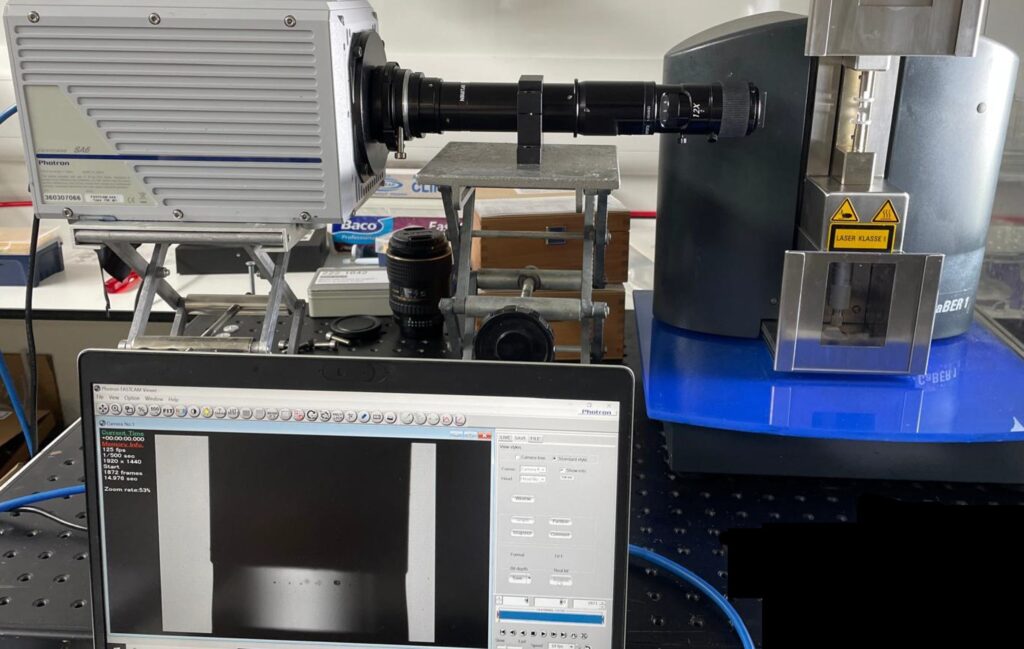
CaBER (right) with a high-speed imaging setup, showing loaded sample on the screen.

Process Optimisation

Stickiness is one of the most undesirable sensory attributes of topical formulations and is closely linked to their extensional rheology. When subjected to stretching, such formulations form liquid filaments often manifesting as “stringiness” during application. The filament thinning can lead to beads-on-a-string (BOAS) formation, where droplets are connected by thin filaments, or to direct filament breakup without any droplet formation, depending on the extensional viscosity (resistance to stretching) of the formulation. Therefore, by tuning formulation parameters such as polymer concentration and molecular weight, both stringiness and droplet formation can be controlled.

A real life example can be found in hand sanitisers. We have previously worked on establishing rheological design principles for thickened alcohol-based hand sanitisers, linking material properties to user experience, including spreadability, runoff and stickiness. By comparing a range of polymer and microgel thickeners, this work identified formulations that balance antimicrobial efficacy with desirable handling characteristics. These findings provide a framework for designing more effective and user-friendly hand hygiene products.

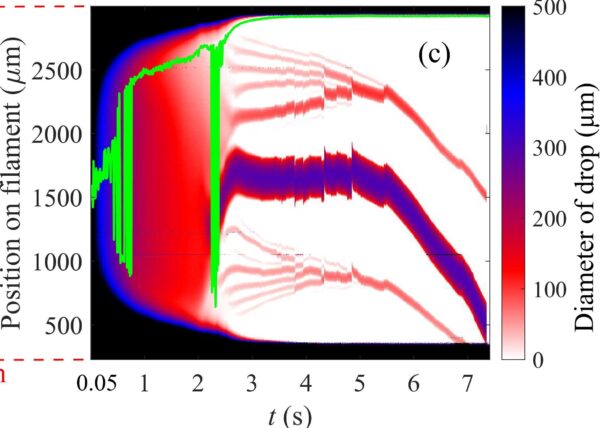
Space–time diagram from high-speed imaging illustrating filament thinning and the resulting BOAS formation. Similar space–time analysis can also be applied to liquid jets to quantify droplet breakup dynamics.

Product characterisation

At ECFP, we use Capillary Breakup Extensional Rheometry (CaBER) to systematically investigate these phenomena under well-controlled extensional flows. CaBER enables control over the stretching height and speed, allowing quantitative characterisation of formulations. When combined with high-speed imaging, it enables filament and drop dynamics to be tracked and analysed in detail. We can also employ droplet-on-surface (DoS) techniques, which is particularly well suited for measuring the extensional viscosity of low-viscosity fluids that are challenging to characterise using conventional extensional rheometry methods. These approaches require only microlitre-scale sample volumes, making them highly cost-effective, particularly for expensive formulations.

Combined with high-speed imaging, our in-house MATLAB analysis code enables automated tracking of filament and droplet dynamics through space–time diagrams. This provides a quantitative assessment of formulation behaviour during stretching and spraying. From these measurements, we extract key metrics relevant to product performance, including extensional viscosity (resistance to stretching), filament thinning rate (associated with stringiness), and droplet formation and size distribution (indicators of spray atomisation). These metrics provide valuable insight into formulation behaviour and can be used to guide optimisation towards desired rheological and performance characteristics.

For example, our of post doc, Dr. Hrishikesh Pingulkar, has previously worked on investigating how viscoelastic liquid filaments stretch and break into droplets during capillary thinning. This study used high-speed imaging and space–time diagrams, to quantify droplet formation, migration and coalescence, providing new insights into the dynamics of filament breakup. The findings revealed how polymer concentration governs both filament evolution and droplet behaviour. These findings advance the understanding of viscoelastic fluid dynamics and support the design of droplet-based technologies used in printing, dispensing, spraying and coating applications.

How can we help you?

Please get in contact with us to find out more about ECFP and whether we can help you.