Understanding defect formation in sustainable coatings
Case study - Notpla
Climate change poses significant environmental challenges, creating an urgent need to develop more environmentally responsible alternatives. One potential solution is the development of materials that can replace conventional plastics, reducing reliance on fossil-based resources and helping to minimise their environmental impact. Bio-based materials offer a promising route towards this transition.
Project partner
Notpla is a UK-based company developing plastic-free alternatives from seaweed and other naturally derived materials. Their materials are designed to replace conventional plastics across a range of applications, including food and consumer-product packaging, as well as dissolvable laundry detergent sachets. In recognition of its work towards reducing plastic waste, Notpla won the Earthshot Prize in the “Build a Waste-Free World” category in 2022.
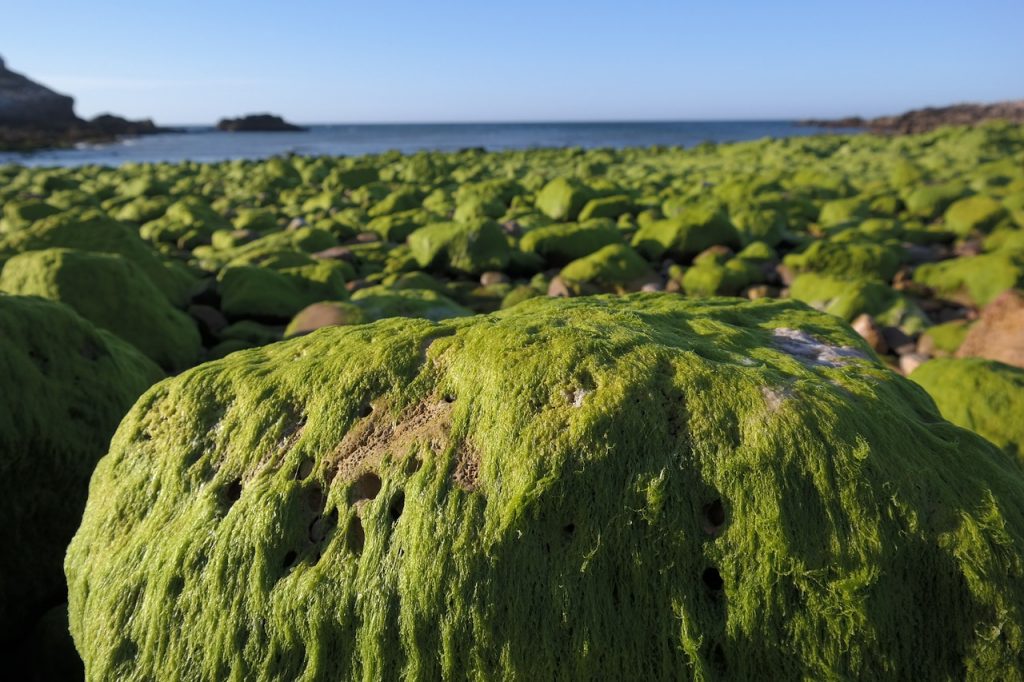
Notpla use seaweed and other naturally derived materials to develop plastic alternatives.
The challenge
Notpla has developed bio-based coatings for paper and cardboard that provide the barrier properties required for packaging while retaining the environmental benefits of bio-based materials. To perform effectively, these coatings must form a thin, continuous, and uniform layer across the paper surface. However, microscopic defects known as pinholes can form within the coating, compromising its barrier performance and potentially affecting the reliability of the final packaging material.
The aim of this project was to develop a better understanding of why, where, and how pinholes form in Notpla’s bio-based barrier coatings. In particular, the work investigated how paper composition, coating formulation, and processing conditions influence defect formation. Understanding these relationships is an important step towards producing more consistent, defect-free coatings and improving their performance and reliability in packaging applications. The project was carried out as part of a University of Edinburgh (UoE) Summer Industrial Studentship by Andreas Mao, with supervision from Dr. Sampat Bhati (Notpla), Dr. Simon Titmuss (UoE), and Dr. Hrishikesh Pingulkar (ECFP and UoE).
Notpla is grateful to Andreas Mao, Dr. Hrishikesh Pingulkar and Dr. Simon Titmuss for helping us better understand how our coating materials perform in combination with different types of board.
How did ECFP help?
ECFP supported the project through providing studentship funding, facilities, and expertise in the characterisation of paper substrates and coatings at different stages of processing. The work involved characterising the paper substrates, wet coatings, and dried coatings, as well as investigating how different coating formulations and coating thicknesses influenced pinhole formation. Notpla provided its commercial NT2P and FB14 coating materials, together with commercial white and brown coating papers, for evaluation.
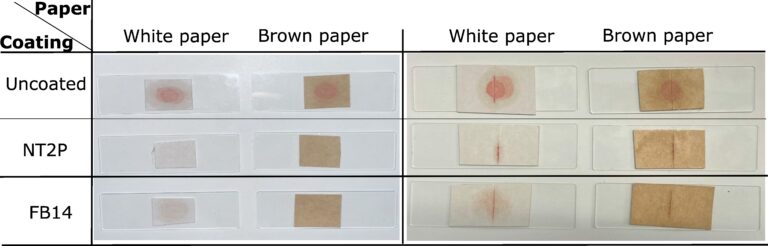
In the first stage of the project, the coating materials were applied to the paper substrates using a doctor blade film applicator to achieve the desired wet film thickness. The coated papers were then dried in an oven according to the drying protocol specified by Notpla. In-house oil-testing methods were subsequently used to identify and assess pinholes and other coating defects (see Fig. 1). The spread of oil across the coated samples was recorded to investigate how and where stains developed. Optical microscopy provided further insight into the relationship between the paper structure and defect formation, including the formation of clusters of stains in regions where paper fibres interweave. These characterisation methods enabled the team to compare different paper substrates, coating formulations, coating thicknesses, and processing conditions, establishing their effects on coating quality, pinhole formation, and barrier performance.
In the second stage of the project, the team investigated how mechanical deformation of the coated paper affects defect formation. A standardised crease test was used to introduce controlled stress into the coating, followed by industry-standard oil testing to assess the resulting defects and oil penetration (see Fig. 1). The tests showed that creasing can increase the number of visible oil stains, highlighting potential defects that may not be apparent in an unstrained coating. The extent and pattern of oil spreading also varied depending on the paper substrate, demonstrating the influence of the underlying paper structure on coating performance.
The experiments further showed that increasing coating thickness can improve barrier performance up to an optimum thickness, helping to reduce oil penetration and prevent leakage. However, increasing the coating thickness beyond this optimum can have the opposite effect. Excessively thick coatings can develop greater internal stresses during drying, increasing the likelihood of cracking or defect formation and consequently reducing barrier performance. These results demonstrated the importance of optimising coating thickness alongside the properties of the paper substrate and processing conditions to achieve defect-free coatings.
Figure 1: Oil-test assessment of different coating formulations on white and brown paper substrates (left) and the effect of creasing on coating defects (right).
How can we help you?
Please get in contact with us to find out more about ECFP and whether we can help you.
We use cookies to optimise our website and our service.
Functional
Always active
The technical storage or access is strictly necessary for the legitimate purpose of enabling the use of a specific service explicitly requested by the subscriber or user, or for the sole purpose of carrying out the transmission of a communication over an electronic communications network.
Preferences
The technical storage or access is necessary for the legitimate purpose of storing preferences that are not requested by the subscriber or user.
Statistics
The technical storage or access that is used exclusively for statistical purposes.The technical storage or access that is used exclusively for anonymous statistical purposes. Without a subpoena, voluntary compliance on the part of your Internet Service Provider, or additional records from a third party, information stored or retrieved for this purpose alone cannot usually be used to identify you.
Marketing
The technical storage or access is required to create user profiles to send advertising, or to track the user on a website or across several websites for similar marketing purposes.