
Practical limits to polydispersity for quality colloidal crystals

A new study by a team from the Soft Matter Physics group uses an experimental approach to systematically explore the link between particle polydispersity and the structure of thin-film colloidal crystals.

15 December 2025

Colloidal crystals find uses across many sectors, from photonic products to fabricating electrode materials for batteries. These crystals can be manufactured through self-assembly from colloidal particles. The spread of particle size (polydispersity) is critical to this process, with high polydispersity limiting crystal growth and resulting in poorer quality crystals. Developing a detailed understanding of how polydispersity links to crystal quality is becoming increasingly important as companies look to use more environmentally friendly methods to synthesis colloidal particles. These greener techniques are often associated with broader particle size distributions.

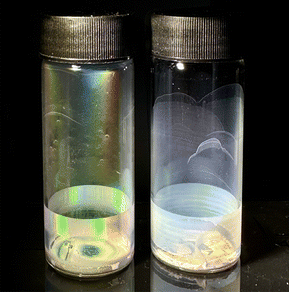
Two test tubes coated with thin film dispersions are shown. One is displaying a variety of colours, the other is opaque and matte in appearance.
Iridescent and matte dried thin films of colloidal crystals. Their differing optical properties arise from the polydispersities of the colloidal particles used to fabricate them. This image is reproduced from Figure 2 in Arif et al. (2025) under a CC BY 3.0 license.

How does polydispersity influence crystal structure?

It is known that crystal quality drops with increasing polydispersity. However, there has been no experimental work that explores this relationship systematically over a range of polydispersities to identify where the critical values lie. The team at Edinburgh undertook such a study and investigated the structure of thin films of colloidal crystals fabricated via vertical drying using silica particles with polydispersities ranging from 6% to 15%. To examine the resulting 2D structures in the dried films, the top layer was imaged using Scanning Electron Microscopy (SEM). The 3D stacking structure of the films was also explored via transmission spectroscopy and via taking cross sections using the Focused Ion Beam of the University’s Cryo-FIB-SEM facility. These cross sections were again imaged using SEM.

As expected, the silica particles in samples with low polydispersity were arranged relatively uniformly in hexagonal packed structures, with this order being lost as polydispersity increased. This loss in structure was seen in both the 2D and 3D SEM images of the films. In particular, the team found significant drops in structural order at 8% and 12% polydispersity. These values provide insight into where the limits lie for manufacturing colloidal crystals from particle systems with higher polydispersity, such as those created using more sustainable synthesis methods. These practical thresholds can help inform process controls and in-line metrology in industrial settings.

Cracks in the films were also seen to increase in shape and size, from relatively narrow cracks at low polydispersity to smooth and wide fractures observed at high polydispersity. This intriguing observation will be investigated further by the team in a future study.

In the top images, spherical particles in a griad can be seen, with much larger cracks in the grid seen in the image on the right. The bottom images show a cross section of the particles, which can be seen to be stacked more uniformly in one image compared to the other.
Top images: SEM images of the top layer of the dried films for a low (left) and high (right) polydispersity assembly (scales bars 1µm). The cracks in high polydispersity system can be seen to be much larger and smoother. Bottom images: Cross-sectional SEM images of the dried films showing the loss of order in higher polydispersity particle assemblies. In a), a film fabricated using low polydispersity particles displays regular stacking across repeating layers. This order is lost in b), where a high polydispersity assembly has more random stacking without the distinct layers seen in a). These images are reproduced from Figures 2 & 4 in Arif et al. (2025) under a CC BY 3.0 license.

Insights into crystal growth mechanisms

The study also provided insights into how the crystals grow as the films dry. For low polydispersity samples, the local order of the crystalline layers was found to increase with the distance from the substrate that the films grew on. The team hypothesised that this could result from the first layer immediately adhering to the solid substrate and therefore keeping the order it had at this time, whilst the second (and subsequent) layers are able to rearrange a little after deposition (via Brownian motion), leading to increased crystal quality. This supports an overall crystal growth picture of 2D layers forming first and then stacking into the 3D assemblies, as previously suggested in the literature for vertical drying.

Are you working with colloidal coatings or thin films and want to investigate how they dry or what particle size variation your process can tolerate? ECFP can help translate particle specs into predictable product performance. Get in touch to discuss collaborative projects and bespoke characterisation.

Links

How can we help you?

Please get in contact with us to find out more about ECFP and whether we can help you.

More Publications...

Controlling friction for sustainable concrete 

ECFP researchers have revealed how friction between microscopic cement grains can prevent the easy flow of fresh, unset concrete. Improving our understanding of these microscale processes will guide efforts to replace cement with more sustainable substitutes.

Read More
There is a table of food and a bottle of raki with two glasses.

Towards a self-mixing salad dressing

A collaboration between researchers from ECFP, the University of Edinburgh, Nottingham Trent University, and Loughborough University studying the behaviour of a popular alcoholic drink has led to new insights into the process of spontaneous emulsification. The work has implications for low-energy production of a whole range of emulsion products which currently must be mixed vigorously.

Read More