ECFP researchers and facilities featured in “Life in the Lab” series

Dr Fraser Laidlaw and Dr David Fairhurst have been featured been in the "Life in the Lab" series created by the School of Physics & Astronomy at the University of Edinburgh.

20 October 2026

What really happens in a physics laboratory? This is the question being answered by the School of Physics and Astronomy’s new “Life in the Lab” series. We’re pleased that researchers from ECFP and some of our facilities have been highlighted in two separate videos: Dr Fraser Laidlaw explores why microstructure matters in a video about our Cryo FIB-SEM facility, while Dr David Fairhurst reveals the physics behind the intriguing ouzo effect and how this can be studied using Optical Coherence Tomography.

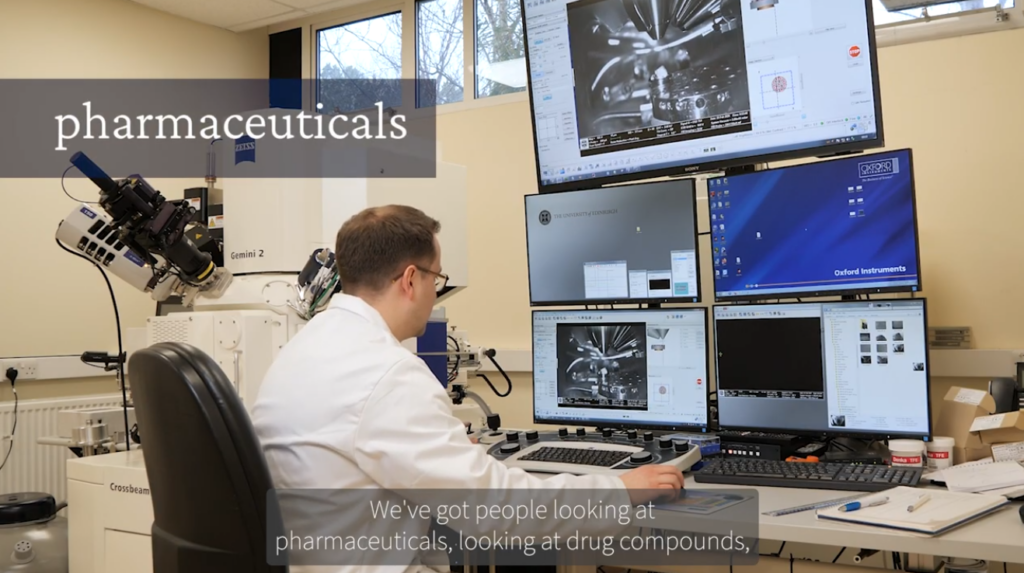
A man is sitting at a desk with multiple computer screens. The screens show various images taken by a microscope.
Dr Fraser Laidlaw discusses some of the sectors that he works with using the Cryo FIB-SEM.

Cryo FIB-SEM facility

The Cryo FIB-SEM facility, managed by Dr Fraser Laidlaw, is available to all researchers across universities and industry. This Zeiss Crossbeam 550 FIB-SEM with cryogenic attachment from Quorum Technologies is one of only a few such instruments in the UK and offers a multitude of powerful techniques to extract as much information as possible from a large range of samples. The microscope offers resolution down to ~1nm, elemental contrast and identification, fast and accurate milling and patterning using the focussed ion beam (FIB), nanoscale tomography, TEM sample preparation and the ability to work on liquids, gels, polymers, biological matter and many other materials using the optional cryo mode.

Some recent examples of materials studied using the microscope include anti-icing coatings, leather, milk, mirrors, and carbon-black gels. For further information on capabilities, feasibilities, fees, training, access and more please contact Dr Laidlaw.

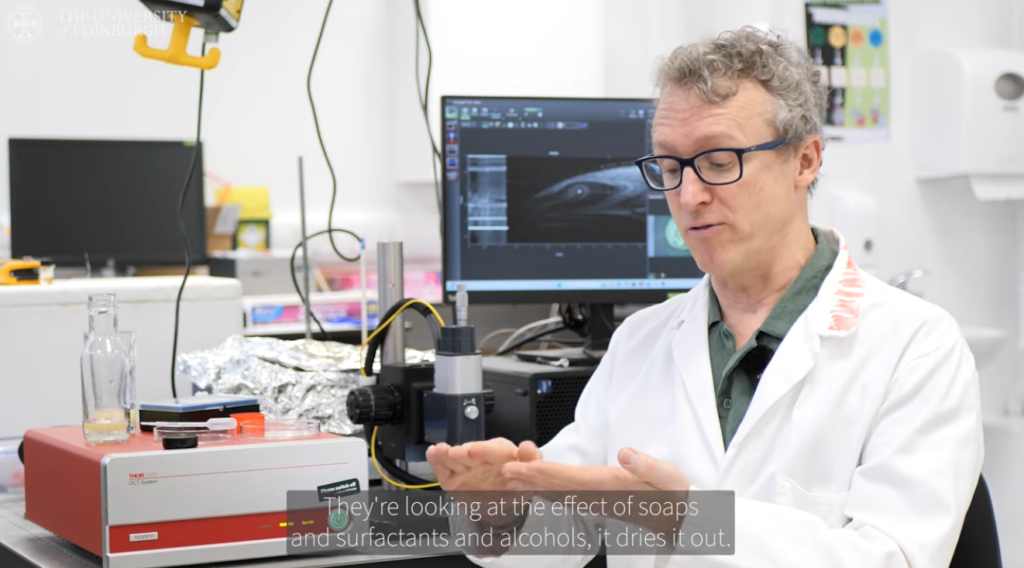
A man is wearing a white lab coat and is sitting in front of some laboratory equipment. He is explaining an idea using his hands.
Dr David Fairhurst explains some of the applications for which optical coherence tomography can be used.

The ouzo effect and Optical Coherence Tomography

When water is added to clear, anise-flavoured spirits such as ouzo, a cloudy emulsion is seen to form. This is called the ouzo effect. Emulsion formation typically requires energy in the form of mixing or shaking, while stabilisers are required to maintain the resulting emulsion (for example, you need to shake salad dressing before serving). However, some systems (like ouzo) exhibit spontaneous emulsification, in which no mixing or shaking is required for the emulsion to form and remain stable. Understanding this phenomenon may help industries develop methods for keeping such liquids mixed while reducing energy costs. Dr Fairhurst describes how he uses optical coherence tomography to study the ouzo effect, as well as other emulsions, consumer products such as soaps and creams, and additional phenomena like sedimentation, drying, and fossil formation.

Links

How can we help you?

Please get in contact with us to find out more about ECFP and whether we can help you.