
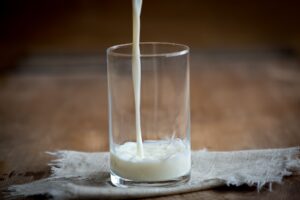
Particle sizing in milk by combined differential dynamic microscopy and cryo-FIB-SEM
Many industrial suspensions such as foods, personal care products and pharmaceuticals, are multimodal in size and heterogeneous in terms of chemical composition. By combining complementary techniques, their components can be characterised to build a more complete picture of their composition.
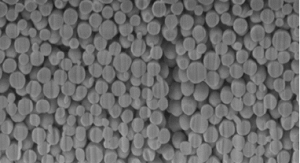
Practical limits to polydispersity for quality colloidal crystals
An experimental approach to systematically explore the link between particle polydispersity and the structure thin-film colloidal crystals.
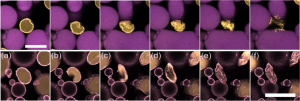
Linking compositional ripening of droplets to interfacial rheology
A new paper led by Dr Raj Tadi from the Soft Matter & Biological Physics group at the University of Edinburgh sheds light on how to control and manipulate compositional ripening in emulsions.

Controlling friction for sustainable concrete
ECFP researchers have revealed how friction between microscopic cement grains can prevent the easy flow of fresh, unset concrete. Improving our understanding of these microscale processes will guide efforts to replace cement with more sustainable substitutes.

Towards a self-mixing salad dressing
A collaboration between researchers from ECFP, the University of Edinburgh, Nottingham Trent University, and Loughborough University studying the behaviour of a popular alcoholic drink has led to new insights into the process of spontaneous emulsification. The work has implications for low-energy production of a whole range of emulsion products which currently must be mixed vigorously.

Thinning, not thickening, fluids optimise protection of glass screens
A collaboration between ECFP and Corning Inc. investigating the link between fluid flow and glass bending in layered systems has uncovered that shear-thinning fluids provide better protection against impact. Such insight could be used to create more durable foldable smartphones.